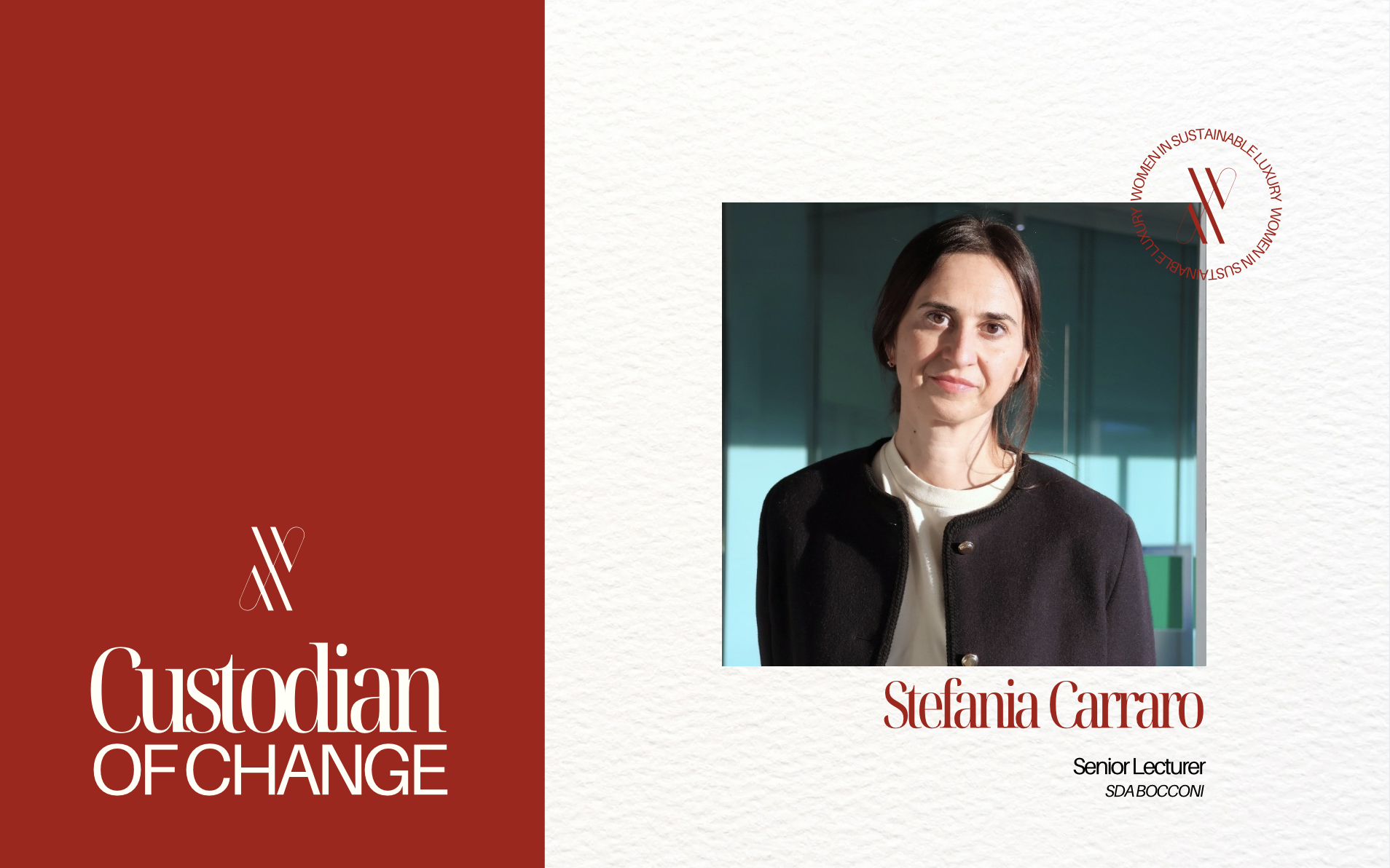
Custodian of Change: Stefania Carraro
Bio
Stefania Carraro is a Senior Lecturer in Sustainability at SDA Bocconi School of Management, where she teaches Corporate Strategy, Corporate Sustainability, and Entrepreneurship in Master and Executive programs. She conducts research within the Sustainability Lab at SDA Bocconi and serves as Director of the Monitor for Furniture Pact, an observatory dedicated to sustainability across the wood–furniture value chain.She is the Vice Director of the Executive Master in Luxury Management (EMiLUX).
Influence & Purpose
WiSL: Tell us about your sphere of influence: the people, ideas, or spaces you shape, and why it matters to you.
SC: My sphere of influence spans the fields of design, sustainability, and strategic transformation. As an engineer and architect, I focus on the physical and systemic dimensions of sustainability; how spaces, production ecosystems, and value chains can be redesigned to generate not only economic value for companies but also long-term value for society. As an academic, I aim to shape the mindset of future leaders in luxury, fashion, and regenerative business models, empowering them to see sustainability as an opportunity for innovation rather than a constraint.
WiSL: What impact are you most proud of creating within your community or industry?
SC: The impact I am most proud of is my ability to create frameworks that bridge the gap between sustainability as a moral imperative and as a business advantage. By helping businesses adopt regenerative practices and encouraging students to think with a systems mindset, I’m contributing to reshaping industries in a way that generates positive value not just for organisations, but for society at large. Seeing the shift in how people view sustainability, moving from compliance to genuine innovation is the change I am most committed to fostering.
Origins & Voice
WiSL: How did you get started in this space, and what helped you find your unique voice as a changemaker?
SC: My journey started with a deeply technical background in engineering and architecture, which naturally led me to explore how the built environment and production systems shape societal well-being. Studying urban regeneration in New York City expanded my perspective and showed me how sustainability can transform entire ecosystems from cities to industries. I later became the founder of a startup focused on sustainable business models, developing a patented solution aimed at generating positive environmental impact in urban solutions. That experience taught me not only how to innovate, but how to operationalise sustainability in real business contexts. My unique voice emerged through this evolution: from technical rigour to entrepreneurial experimentation, always guided by a clear purpose to make a measurable positive impact across the different dimensions of sustainability. I found strength in my interdisciplinary perspective, which allows me to bridge worlds that often remain separated: industry and academia, creativity and analysis, purpose and performance.
Visibility & Misunderstanding
WiSL: What’s something you wish more people understood about your work or the change you’re driving?
SC: I wish more people understood that sustainability is not an optional layer or a reputational exercise it is the only viable path to creating and maintaining long-term value. In business, sustainability is fundamentally connected to risk management, particularly long-term environmental, social, and supply-chain risks. Companies that embed sustainability strategically are more resilient, more innovative, and better prepared for systemic challenges. Sustainability is not a checklist; it is a profound, multi-dimensional transformation. It requires cultural change, strategic alignment, systemic thinking, and a willingness to question established models. The work is about redesigning systems to be regenerative, resilient, and future-fit, creating positive impact while protecting value for the long term.
Values & Alignment
WiSL: What personal values guide your work, and how do they make you the best person for the career you’ve designed for yourself?
SC: My work is grounded in integrity, curiosity, responsibility, and ambition; a commitment to always raise the bar. As a former athlete, I learned discipline, resilience, and the drive to push beyond perceived limits. That mindset has shaped my professional identity: I welcome challenges, I stretch boundaries, and I pursue excellence with purpose. Collaboration is also one of my core values. I believe deeply in sharing knowledge and co-creating solutions, because meaningful sustainability outcomes emerge from collective intelligence, not individual effort. Working with others: students, colleagues, and companies, enriches my perspective and amplifies the positive impact we can achieve together. These values make me uniquely aligned with my career path: I bring rigorous technical grounding, strategic vision, and a collaborative spirit to every initiative I lead or support.
The Everyday Reality
WiSL: On challenging days, what does your work look or feel like behind the scenes?
SC: On challenging days, the work feels like navigating multiple layers of complexity, balancing long-term sustainability ambitions with short-term operational realities, or encouraging organisations to rethink deeply embedded habits. Progress can be slow, and the work often requires patience, negotiation, and resilience.
WiSL: On days when you remember why you started, what moments bring you joy and affirmation?
SC: The moments that remind me why I started are abundant: when a student has an “aha” moment, when a company adopts a regenerative strategy they once thought impossible, when a design proposal opens new ways of thinking. These moments reaffirm that change is possible and that I am privileged to contribute to it.
Reflection & Growth
WiSL: Looking back, what advice would you give to yourself at the beginning of this journey?
SC: I would tell my younger self to trust the value of interdisciplinary thinking, even when it feels unconventional. My path spanning engineering, architecture, urban regeneration, entrepreneurship, and academic research focus on fashion and luxury sustainability, has taught me that the ability to integrate different perspectives is one of the most powerful tools for driving change. I would also remind myself that transformation takes time; resilience and consistency matter as much as innovation.
WiSL: What leadership qualities are you currently nurturing, and how are you actively developing them?
SC: Today, I am nurturing qualities such as systems leadership, collaborative intelligence, and strategic foresight. I am strengthening my ability to guide collective processes of change, connect diverse stakeholders, and anticipate emerging risks and opportunities. I develop these qualities through research, teaching, advisory work, and ongoing dialogue with peers who challenge and inspire me.
Words by: Stefania Carraro