Custodian of Change: Nancy Johnston
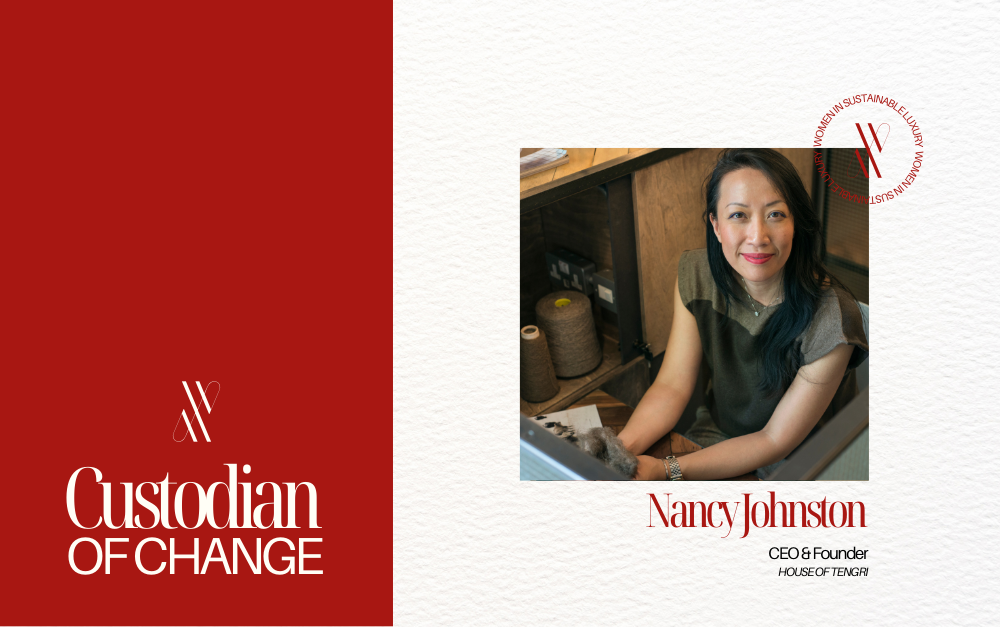
Bio
Nancy Johnston is a multi-award-winning entrepreneur and regenerative designer, and the Founder of House of Tengri, pioneering new standards for rare and noble fibres in luxury fashion and textiles. Her work redefines how luxury materials are sourced, building new supply chains with nomadic communities while safeguarding cultural heritage, craftsmanship and mountain biodiversity.
With a foundation in Social Work, she brings a human-centred approach to systems change and sustainable commerce. She is a consultant to the UN Food & Agriculture Organisation, an advisor to the Royal Government of Bhutan, and a regular lecturer at Central Saint Martins and Vogue College of Fashion.
Influence & Purpose
WiSL: Tell us about your sphere of influence: the people, ideas, or spaces you shape, and why it matters to you.
NJ: My sphere of influence lies where cultural heritage, craft, design, conservation and art intersect. I collaborate with nomadic herders, master artisans, heritage manufacturers, scientists, and creative designers to reimagine luxury not as extraction, but as regeneration. Through the Tengri Way, we weave together ancient mountain and urban worlds, establishing circular economies that honour heritage, ecosystems and communities.
WiSL: What impact are you most proud of creating within your community or industry?
NJ: What moves me most is that the House of Tengri was built from the ground up, a grassroots, co-creative journey involving herders, heritage weavers and consumers alike. I am deeply proud of creating the Tengri Way: a global movement, transparent supply chain and methodology that demonstrates how nature’s noble fibres and ancestral ways, when paired with contemporary design and systems innovation, can protect livelihoods, biodiversity and cultural legacy. Luxury, in this context, becomes a force for good.
Origins & Voice
WiSL: How did you get started in this space, and what helped you find your unique voice as a changemaker?
NJ: My journey began in Mongolia’s Khangai Mountains, with a simple yet profound question: what if the world’s most ancient noble fibres could redefine the future of luxury? That encounter with nomadic herders changed everything. It led to the creation of the House of Tengri, a brand born from deep listening: to people, place, and tradition.
I didn’t recognise myself as a changemaker until I won the Asian Woman of Achievement Award, and I found my voice not by competing within the industry, but by standing outside it and belonging to the least likely of organisations, the Mongolian Federation of Pasture Users Group.
With 2026 declared by the United Nations as the International Year of Rangelands and Pastoralists (IYRP), I am honoured to be appointed an honorary member, helping represent and give voice to nomadic herders within the global luxury marketplace. My voice, woven from activism and artistry, is grounded in the belief that business can and must be a force for good and a pathway for regeneration.
Visibility & Misunderstanding
WiSL: What’s something you wish more people understood about your work or the change you’re driving?
NJ: People often mistake my work for fashion and fabrics. It’s far deeper than that. The House of Tengri isn’t about producing products; it’s about transforming the system. It’s a design philosophy, a regenerative renaissance, and a movement that bridges worlds through ancient noble fibres.
I wish more people understood that textiles are not just materials, and to be truly sustainable, every aspect of the supply chain needs to be respected and considered. From the harvest of raw fibres available once a year, only 100 grammes are available and handcombed when the Khangai yaks shed their first winter coat in the spring. From there, the journey to create a single ream of fabric can take up to eighteen months and requires artistry, skill and precision. Fabrics are social and ecological systems. Every thread tells a story of identity, climate, culture, community and place. My work aims to make the invisible threads of the ancient Silk Road visible again, connecting East and West with a more equitable narrative.
Values & Alignment
WiSL: What personal values guide your work, and how do they make you the best person for the career you’ve designed for yourself?
NJ: The values that guide me are respect, reciprocity, and regeneration. Respect for people, planet and animals. Reciprocity that ensures everyone along the supply chain benefits. Regeneration as the ultimate measure of success, where the land, communities, cultures and all living beings thrive because of our work.
These values have led me to recognise a path that started as a social worker to become a steward leader, navigating between business and belonging, luxury and humility, heritage and innovation. I don’t just make rare fabrics; I cultivate ecosystems of meaning and integrity and one that is deeply concerned for the conservation of cultural heritage, craft, communities and ecosystems and to ensure the wellbeing of all.
The Everyday Reality
WiSL: On challenging days, what does your work look or feel like behind the scenes?
NJ: On challenging days, the work feels like navigating a tapestry with tangled threads: balancing global supply chains, manufacturing complexities, cultural differences and market pressures while holding onto our ethical compass. It’s often a quiet, unseen labour of love.
WiSL: On days when you remember why you started, what moments bring you joy and affirmation?
NJ: On good days, I’m reminded why I started. Those moments of continuity, dignity, and connection are the real measure of success.
Reflection & Growth
WiSL: Looking back, what advice would you give to yourself at the beginning of this journey?
NJ: If I could speak to my younger self, I’d say: Trust the quiet path and ride the cosmic wave. The right people will find you when your work is rooted in truth. I would remind myself that regeneration takes time, like tending a landscape, not launching a product.
WiSL: What leadership qualities are you currently nurturing, and how are you actively developing them?
NJ: Today, I’m nurturing the qualities of collaborative and steward leadership and deep listening; being a bridge and facilitator from the middle, not the top. I’m learning to create space for others to lead, to turn influence into invitation. Growth, for me, is measured in how many others I can help through the House of Tengri journey.
Words by: Nancy Johnston