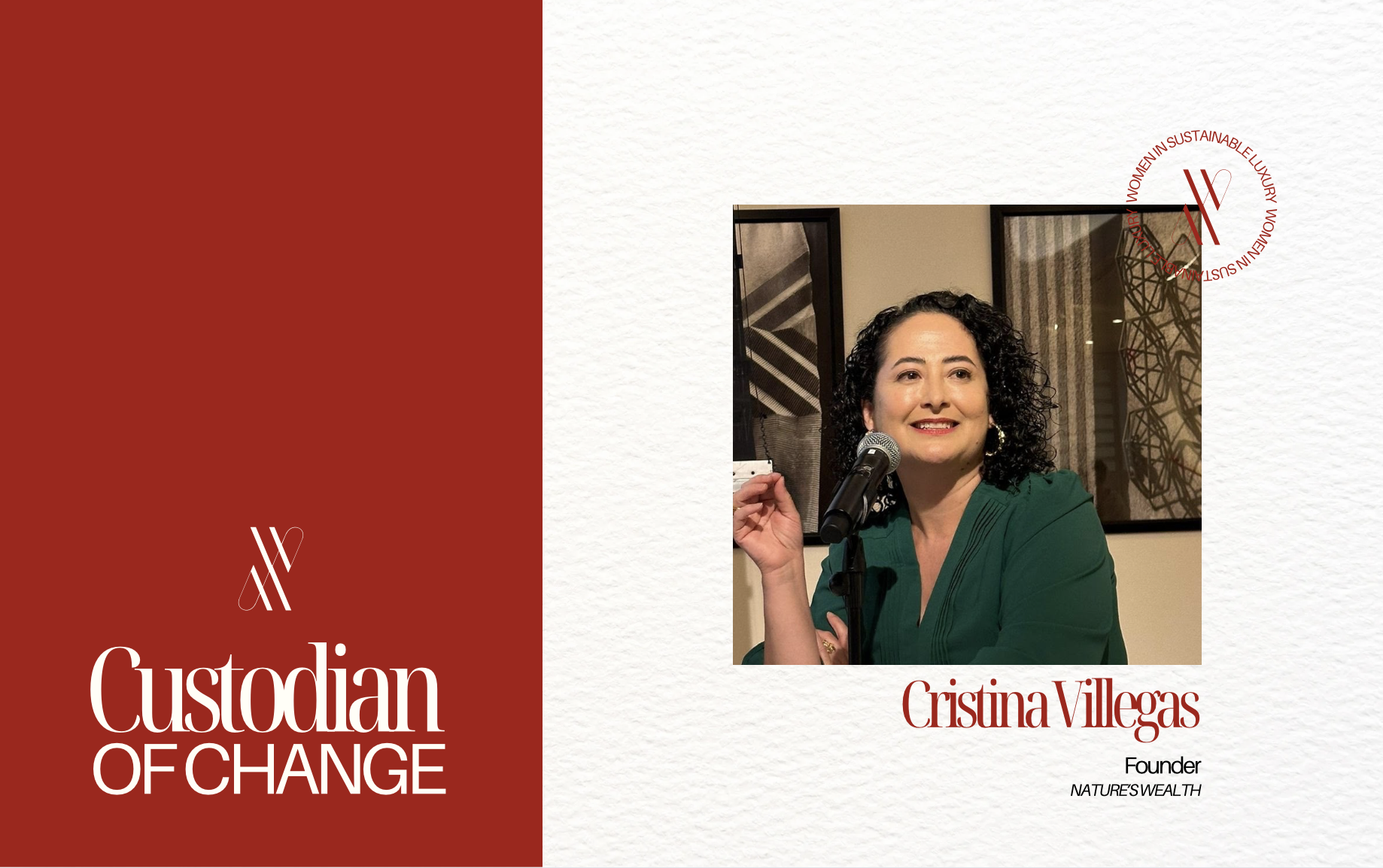
Custodian of Change: Crisitina Maria Villegas
Bio
Cristina Maria Villegas is the Founder and Director of Nature’s Wealth, LLC. She is an award-winning independent consultant in sustainability focusing on the intersections of global business, responsible sourcing, and rural development. Her specialities lie in ‘critical minerals’ and jewellery-relevant materials, helping organisations engage with the origin of their raw material supply chain, from Africa to Asia to Latin America. She is also a recurring faculty member at Columbia University for their Executive Course on Extractive Industries and Sustainable Development.
Influence & Purpose
WiSL: Tell us about your sphere of influence: the people, ideas, or spaces you shape, and why it matters to you.
CMV: I focus on demystifying and bridging two worlds: luxury retail goods and those whom I call ‘the world’s hidden suppliers’: the women and men who mine everything that we need for all of our products. Most people forget that literally every product in our homes, in our offices, and that we purchase, came from a farm or from a mine. This includes the rings on our fingers, the cosmetics on our faces, the phones in our hands, the cars that we drive, and so on.
I am most well known for shaping the sustainability movement in jewellery. However, I do also work in tech and auto supply chains. Everyone just seems to be enamoured with jewellery, and I know why: it’s art. Jewellery is highly personal because we seek it out and we give it meaning. This also means that both retailers and consumers themselves can be deeply affected when they understand some of the horrific circumstances that they may be inadvertently contributing to.
What I choose to focus on is the solutions. I do not like to simply point out problems. I like showing people what they can do next. I think that’s why I have managed to get traction. It is because of this approach that, last year, Women In Mining UK named me as one of the global 100 ‘Most Inspiring Women In Mining’.
WiSL: What impact are you most proud of creating within your community or industry?
CMV: I am most well known for shaping the sustainability movement in jewellery. This involved deep engagement of the industry and demystifying mining to them. There are many ‘vested interests’ in the jewellery industry who benefit from opacity in mineral supply chains and who do not want things to change. But, fortunately, there are many more people who are curious about change and that understand that every sector must modernise. Slowly, the sector is beginning to understand that modern slavery is in its supply chains, that the worst environmental crimes on the planet, and more, are fueled by gold, but that there are highly practical ways forward.
In terms of specific impacts, I’m proudest of two things so far in my career.
First is my work to reform the coloured gemstone space (think rubies, sapphires, emeralds, garnets). Working hand-in-hand with women gemstone miners and reform-minded coloured gemstone traders, I launched the MoyoGems program in 2019 while at my previous employer. It centres on the needs and ambitions of women miners, along with their wonderful male allies, to get them gemstone prices that were between 3 to 10 times their previous earnings. Those women’s products are in luxury collections, have been in Paris Fashion Week three times, and are carried by major brands showcasing their values alongside their designs. I’m most pleased that MoyoGems has influenced and inspired other work around the world. This work was done by team, of course, and I was delighted to be at the helm until my transition to independent consulting.
Second, I’m proud of my work to build and strengthen organisations in the global south. I have a unique megaphone because of my base in the United States. If you have worked alongside me, you are well aware that I seek out the expertise and talent wherever I am working. I’m also obsessed with developing and mentoring talent in-country, or receiving that mentoring myself. Practically speaking, this means raising money for other organisations, dividing large grants with partner organisations, and asking them what they need to get to the next level. These can be extremely high-performing groups, but they just do not have the visibility that others do because of language or geography.
Origins & Voice
WiSL: How did you get started in this space, and what helped you find your unique voice as a changemaker?
CMV: Early in my career, I was working for the Fund for Global Human Rights in its startup phase. More and more of its funding was going to environmental justice work and to topics intertwined with corporate supply chains, human rights, indigenous rights, illegal mining, and so on. I was profoundly interested in the core issue: corporate supply chains. What would happen if those could be managed better? Could the other issues be prevented or, at least, reduced?
So I decided to try to study this in graduate school at the London School of Economics, and I accidentally wound up working for one of the emerging experts on diamond supply chains, Estelle Levin. I would become her first employee, gained an enormous amount of field experience on the front lines of the world’s largest gold rush in 2010, and in the passage of landmark legislation in the US and Europe focused on gold and other ‘conflict’ minerals. My early projects helped the industry figure out how to respond when there were no systems in place.
I moved from the UK, started a company in the US, and was then quickly recruited to a large nonprofit called Pact because of my jewellery and tech mineral supply chain expertise. For more than a decade, I built and ultimately ran Pact’s responsible supply chain programs, including transitioning children out of horrific child exploitation situations to long-term success, developing high-value commercial programs for women miners, imagining and implementing carbon-insetting programs, and more. In 2025, I transitioned into private consulting, and now I help companies map their supply chains, understand their risks, manage and mitigate, and lean in on their sustainability goals for consumer storytelling and social impact.
Visibility & Misunderstanding
WiSL: What’s something you wish more people understood about your work or the change you’re driving?
CMV: I find that most people are scared about what they might discover. This is the mining industry, after all. The sector has a certain reputation for a reason. But the responsible sourcing world is one where we can typically prioritise risks and actions. An experienced guide can help you understand what you are seeing, what the options are, what to prioritise first, and what can be done alongside others (yes, there are usually allies available!)
And, sometimes, mapping supply chains turns out to be not-so-scary at all. Sometimes, you can find some wonderful surprises and stories that you can lean into. This world is full of good and bad. There are very few ‘impossible’ situations. That’s where the right expertise and experience comes in.
Values & Alignment
WiSL: What personal values guide your work, and how do they make you the best person for the career you’ve designed for yourself?
CMV: My approach is highly collaborative, results-driven, and emphasises value for money. Because I spent so much of my career with mining communities and understanding real-world incentives along the value chain, I offer a unique humility, geographic intelligence, pragmatic approaches, and deeper insights that others simply will not have due to a lack of practical field implementation experience. I often joke that despite my youthful appearance, I’m actually one of the sector’s most experienced veterans with 20+ years of practical experience. I’ve worked across more than 30 countries on three continents, visited 300-500 mines, and across jewellery, homewares, tech, auto, energy, and even construction. Yet, hopefully, every single person will find me instantly approachable.
The Everyday Reality
WiSL: On challenging days, what does your work look or feel like behind the scenes?
CMV: To be honest, on challenging days, sometimes the vested interests win. There have been two contexts where I have walked away where I realised the political dynamics made prospective work simply not possible. Reformers do not always succeed.
Fortunately, I am experienced enough in my career that I can now understand how to ‘opportunity-spot.’ Experience over time has taught me how to see potential for real system change, I can see the ‘hidden’ social and physical infrastructure on which to build, identify the allies in diverse retail and wholesale industries, engage executive leaders and boards, and I always engage with pragmatism. I understand that achieving perfection is impossible and we all must start somewhere. The hardest part is always the courage to start, so my role now is to help companies feel safe in doing that. There’s always a positive step that they can take.
Reflection & Growth
WiSL: What leadership qualities are you currently nurturing, and how are you actively developing them?
CMV: In my consulting practice, Nature’s Wealth LLC, I’m cultivating adaptive leadership, the capacity to hold and act upon complexity. I help clients understand complex ESG and supply chain challenges in clear, strategic terms, and then guide them toward right-sized, practical solutions that fit their supply chains, risk tolerance, and sustainability goals.
To stay effective, I prioritise continuous learning on emerging regulations, and I routinely carve out time for reflection and client feedback. But the most meaningful part of my development comes from listening closely to people across the mineral supply chain: miners, traders, community leaders, and others whose experiences rarely make it into official reports. Those conversations ground me. They remind me why this work matters, they remind me who is being included and who is not (and why), and they shape the guidance I bring to my clients. I wish more sustainability professionals would come to the field with me. It would open a lot of eyes.
Words by: Cristina Maria Villegas